Monday, July 12, 2021

Found Happiness with Mary and God - A Spiritual Autobiography

What follows is a Spiritual Autobiography I put together with the help of a couple of friends. It was meant to be shared in person and presented aloud. So packing 68 years of spiritual life into 30 minutes was a challenge, but also I think worthwhile. Here's what I came up with.  

 Introduction

“In the beginning was the Word, and the Word was with God, and the Word was God.” John 1:1

As I looked back on my spiritual journey, I became aware that my love of reading and the spoken word has had a tremendous impact on choices I made, and these loves will undoubtedly continue to influence my choices. I can point to quotes from authors such as C. S. Lewis, Kathleen Norris, Thomas Merton, and others that have been influential in my understanding of myself. I have also found the words of friends, colleagues, and my spiritual director have helped me make decisions along the way. In going through this autobiography process, I have discovered these words still have the power to move me. So, I have broken my life into “Steps” in my journey and led off each step with a quote that played a role in that period of my life.


Step 1: My Baptism and Childhood Christianity

“Richard Lee Gatjens, you are sealed by the Holy Spirit in Baptism and marked as Christ’s own forever.”

Those words from the Book of Common Prayer were undoubtedly spoken at my baptism at St. Paul’s Episcopal Church in Seattle, Washington. I was a baby, and I have no memory of that event. I don’t even remember talking about it, but I did know that I was baptized Episcopalian. It would be 45 years after my baptism before it led me back into an Episcopal church to worship. I find it intriguing that this ceremony would shape my future spiritual life so profoundly.

My family moved out of Seattle to a rural area 20 miles north, when I was less than 2 years old. My parents were concerned about our spiritual upbringing, yet when the time came to pick a church, my parents did not choose a local Episcopal church. They chose Alderwood Manor Community Church, a non-doctrinal Protestant church, because it was close and they had an active children’s program. I remember going to Summer Bible School there. Each day would begin with us singing “Onward Christian Soldiers” outside the church, before proceeding to the undercroft to listen to Bible stories and create pictures of Jesus Christ surrounded by children and sheep.

But I never developed a feeling of belonging to the Community Church. In junior high, I thought about becoming a priest, but I remember meeting with a friend’s father who was a minister and telling him that I had no idea what faith I belonged to.

Step 2: Separation from the Christian Faith

“I don’t believe there is anything after death, and I’m glad.”

I had a classmate in high school, Debbie, who made this pronouncement at a play rehearsal. For most of my young life, I had been afraid of dying. I had been raised a Christian, but I had severe doubts about the existence of God and an afterlife. I had spent many sleepless nights worrying over what would happen to my “soul” after death. To hear Debbie say that she had no fear of death gave me pause. What was so terrible about nothingness? I think this was a turning point in my willingness to admit to myself that I was an agnostic or atheist. God was on the backburner of my life for the next 25 years. I don’t think this made me a bad person, but it perhaps made me an emptier person. I was still guided by the same ethics and morals instilled in me as a child, I just didn’t see God in it.

In college, I had a friend who practiced Transcendental Meditation. I was interested, so he taught me a way to meditate with him. Meditation of various sorts would continue to arise and recede as a spiritual practice from then onwards. Currently, I love the practice of Centering Prayer, which is a form of Christian meditation. In college, I was not seeking interaction with the divine, however, but looking for a way to calm my own inner self, as I can be prone to anxious, sleepless nights over even little mistakes.

Step 3: The Big Leap

“I ate apple pie and ice cream—it was getting better as I got deeper into Iowa, the pie bigger, the ice cream richer.”--Jack Kerouac, On the Road

In March of 1978, I got on a Continental Trailways bus bound for New York City. One of my favorite novels at the time was Jack Kerouac’s On the Road, in which he traces various trips he made back and forth from coast to coast. On his first trip, he talks about how he didn’t have much money to spend on food, so he thought apple pie and ice cream was the cheapest, yet still nutritious, thing he could eat. On my four-and-a-half-day trip I had more than one apple pie and ice cream in tribute. I also found a salvation, of sorts, in Iowa.

I grew afraid as the bus pulled out of Seattle, wondering what I was doing. I had $750 in my pocket traveling across the country to a place I had never been, with only my friend Debbie in New York City to help me get set up. Yet somewhere in Iowa, I began to feel calmer, more confident, and from that point on I felt that I was going to be all right. That no matter what happened, I would find a way to continue.

I spoke to my TM friend afterwards about the trip, and he told me that the TM organization had a headquarters in Iowa, and one of the things they do there is send out positive vibes to the world around them. So as my bus drew closer, in his opinion, I received more and stronger vibes from them. I am skeptical of this particular interpretation, but I do believe that positive thoughts can have an impact on other people, so who knows? Their work may have had an impact on me on that lonely bus ride. If so, thank you!

Another interesting event of the trip happened when my bus pulled into Cleveland, Ohio. We had a dinner break, and while I was waiting for the bus to leave, I found a newspaper with an ad for a play that was being performed just around the corner from the bus station. One of the performers was a college friend of mine, Karen. I had no idea she was in Cleveland. It seemed too preordained to ignore. I found out I could take a later bus, so I went to the theater and got there just in time for the curtain call at the end of the play. I stood backstage as Karen came off. She took me back to her apartment so we could talk and I could take a shower before catching the next bus to New York. Looking back, it feels like this was a chance to say good-bye to my life in Seattle. I was committed to a new place and life that Seattle had prepared me for.

Step 4: New Start in New York

Interviewer: “How can I make myself want God enough to enable myself to find him?”

C. S.:“If you don’t want God, why are you so anxious to want to want him? … I should say that this person has in fact found God. … At any rate, what is more important is that God has found this person, and that is the main thing.”--C.S. Lewis in a radio interview.

I met Mary at American Management Association in 1981. We were just friends until she was laid off. This prompted us to step up the relationship that has lasted until this day. It was not a storybook romance. We have dealt with a number of issues over the years, some I found very difficult to handle. Eventually I found myself spending lunch hours at St. Thomas Episcopal Church at midtown, looking for peace and space to think.

When I thought about why I had chosen St. Thomas as my refuge, I began to wonder if this was a return to church. Had God found me again in New York City? I felt drawn first to investigate the Episcopal church because of my baptism. I had been reading Kathleen Norris’s book Dakota, and one passage about her return to South Dakota particularly resonated with me:

“T.S. Eliot wrote, ‘The end of all our exploring/Will be to arrive where we started/And know the place for the first time.’ Against all odds, I rediscovered the religion I was born to, and found in it a home.”

 A friend of mine at work was a practicing Catholic, and I felt I could talk to him about my feelings. He would go to mass at St. Patrick’s at noontime, and I found a nearby Episcopal church that also had noontime mass. We would compare notes afterwards. I did not feel comfortable sharing this with Mary, because she was a committed EX Catholic and generally opposed to organized religion.

Eventually, I found an Episcopal church in my neighborhood and told Mary what I was up to; she surprised me by how supportive she was. She didn’t want to go to church with me, but she encouraged me to follow my instincts and became good friends with my priest, Father Larry.

I believe my faith enabled me to deal better with subsequent crises, and I think Mary and I are both closer and happier as a result.

Step 5: Maryknoll

“We are called to serve one another, to walk humbly with God.”--David Haas

"Pay attention. This will be over in a blink of an eye."--Joe Regotti

I was still in the early stages of finding God in the Episcopal Church when I came to work at Maryknoll Mission Association of the Faithful. It turned out to be the perfect place for me to be. If I wanted to discuss spiritual matters, there was an abundance of people willing to do that with me. Two people who played the largest role in my development spiritually were Joe Regotti and Jean Walsh, two lay missioners who had returned from mission when Joe was found to have a brain tumor. For thirteen years Joe was on staff and he was a frequent lunch companion. He was a real mentor to me and helped me see my own relationship with God more clearly. Jean was my partner in anti-racism activities and epitomized to me hospitality and spiritual joy. No one I know has a more full-bodied laugh than her.

Other missioners and staff prompted conversations that made me feel more confident in my spirituality. I felt better able to share my faith thanks to their encouragement. Thanks to my work at Maryknoll, I was also able to take the next step, which enhanced my spiritual life more than any step so far.

Step 6: Contemplative Formation Program at Mariandale

“Just say yes.”

This is a phrase frequently intoned by my spiritual director and the instructors at Mariandale. It was a long winding road to the program that would impact my spiritual life more than any other event. It began when I was having lunch with a friend, Karen. In the days before our lunch, I felt I should ask her about spiritual direction. I had thought off and on that it might be helpful to me in my efforts to draw closer to God, yet I wasn’t even sure exactly what it was. Nor did I understand why I was feeling compelled to ask my friend. I had no idea of her relationship, if any, to the process. But I asked her anyway, just saying yes to the impulse.

 “Funny you should ask.” she said. “I know a Maryknoll Sister who is a spiritual director and is looking for new clients.” Karen gave me the sister’s e-mail, who agreed to have lunch with me. Then she decided she didn’t really want any new clients, but would have lunch with me anyway. At the end of our lunch, which I enjoyed very much, she told me, “I can give you names of possible directors, but what I want to really recommend is that you take the Contemplative Formation program.”

I took her advice and applied for the program. It was like applying for college: filling out forms, collecting references, attending interviews. After finally being accepted, they told me I had to get a spiritual director to be part of the program. I had come full circle. I ended up working with a former lay missioner, Jeanine, who had recently gotten certified. I have enjoyed and continued the spiritual direction experience with her.

I found the program challenging at first, but eventually I realized this was where I needed to be. It has altered my daily life, so that I am more outward thinking. It has made me happy and feel that I am really on the right track to becoming a better person. I feel so grateful that God has led me to this place, even if I never saw it coming.

Step 7: Where I am now and Where I am going

"Our last five minutes on earth are running out. We can spend those moments in meanness ... or we can spend them consciously embracing every glowing soul who wanders within our reach."--Alice Walker

So where has my journey brought me? It has brought me to a place where I realize I am never going to hear God’s voice telling me what to do, like King Arthur does in Monty Python’s Holy Grail. The path ahead is never obvious, but I move forward by trusting my own instincts. I think that Thomas Merton best expressed where I am in my journey today and where it might lead.

“My Lord God, I have no idea where I am going. I do not see the road ahead of me. I cannot know for certain where it will end. Nor do I really know myself, and the fact that I think that I am following your will does not mean that I am actually doing so. But I believe that the desire to please you does in fact please you.”

Amen. That last sentence I quoted from Merton is probably my biggest new understanding I gained from writing this piece. Thank you.

Wednesday, July 3, 2019

Finishing the Program and Continuing On Day by Day by Day by Day

"Oh! Turkeys!" Bruce, one of our facilitators suddenly exclaimed in the beginning of his presentation on our final weekend of the Contemplative Formation program  at Mariandale. We were on the ground floor, and the windows looked out on an area where the ground was actually higher than our floor, so we had a clear view of the three turkeys that appeared just outside the window. "Oh my!" he exclaimed, as two of the turkeys suddenly felt in the mood for propagation. It was a comedic highlight of the last three days we would all spend together.

I have been putting off this final blog about the Contemplative Formation program, because I wasn't sure what I wanted to say. I have just had lunch with my friend Mary Ann, and I think she helped me with a few perceptive questions.

When I said that the program had been life-changing, she asked me in what way, as she felt I had been very contemplative for years. I think that I've been unaware of this, actually. I admit that I've had other people (including my spiritual director) tell me this as well, since I started the program. But the label was not one I would have given myself. So what I gained in particular from this program was a realization that being contemplative on a daily basis for the rest of my life is what I really want. By using the label "contemplative" it gives a real sense of direction to my journey.

Previously, I was reading a lot of religious texts, trying various practices, praying for others, going to church, etc., but merely because I felt drawn to it, but not because I knew what I was doing. I was taking a scattershot approach to becoming more spiritual: reading this book or that, trying one type of prayer or another, but not really having a method to my madness. It was only when I heard our facilitator of the small group say to us about three months into the program that "You have been called to this since birth ..." at that moment, I really felt "yes, this is what I want and this is what God wants for me." The search for a roadmap is over, but I still have a long journey ahead of me.

My life has changed, because each day I try to be awake to God's blessings and presence in the people around me. I think of my personal heroes, missioners who gave me full attention when we were together, and I strive to do that with the people I encounter. It's not always easy. After church recently, a man who occasionally comes to my church sat across from me at the coffee hour and began to speak to me. He engaged in a long rambling story, and I soon realized he had some serious psychological issues, but the only gift I could give him was to listen. He occasionally asked me questions, but since I couldn't follow his train of thought, all I could do was nod. When he finally finished his discourse, the only thing I could think of to say was, "I am glad we [the church] were able to provide you with a short time of peace in this tempestuous world." He thanked me, and we parted with good feelings.

I used a quote from Pope Francis in one of our acknowledgment letters recently, and it seems appropriate here: "Whatever we have can bear fruit if we give it away - that is what Jesus wants to tell us - and it does not matter whether it is great or small. The Lord does great things with our littleness." I felt pretty little in my time with the gentleman at my church; I just pray for great things to result. I hope he will return, we are all broken and we all need places where we fill welcome.

I was pleased with the final bit of our last weekend; we had an actual graduation ceremony, which I didn't expect. It reminded me of MKLM's Covenant Signing ceremony for new missioners. The missioners are called forward one by one, sign the Lay Missioner Covenant in front of the staff, and then receive a hug from the Director and their witnesses. Then all missioners, current and former, recite the Covenant together. For our graduation, we were called forward to receive a prayer shawl and a congratulatory hug from the facilitators, then we signed a book containing the names of all who have completed the program, and the facilitators read us a pledge to be Contemplatives.

After ten months containing many hours of discussion and sharing, doing practices each day, it felt a fitting end as we all committed to remaining pilgrims on the journey toward God and helping others find their way. I have a confidence now that I didn't have before. An ability to face death with peace in my heart, and an understanding that there will be ups and downs along the way, but the journey will be ever forward. I can't wait to find out what's around the next corner. Pray for me, and I'll pray for you.


Tuesday, May 28, 2019

If You Want to Be Happy, Practice Compassion

The theme of our retreat this month was "Compassion, Healing and Gratitude." You would think that I would be in for a pleasanter experience than the previous weekend retreat, whose theme was "Suffering," but I seem to always find a way to surprise myself.

Let me begin by stepping back a few weeks. We had our last small-group Contemplative meeting in April, and we have drawn ever closer as a group over the previous months, so I decided to bake a cherry pie to share and celebrate, using the pie carrier I had been given by group member Carol.
Fortunately, it came out well, and everyone seemed to enjoy it (plus I managed to bring a couple of pieces home for Mary). The group has provided such a warm, accepting presence as we shared our good times and bad along this contemplative journey, I shall miss them, but perhaps we can continue somehow afterwards. The weekend began this month with Carol, a small-group member, taking me aside to thank me for the pie and inviting me to eat dinner with her at one of the tables outside, which was a real treat that we repeated (even when our meals were in silence) over the weekend, since we had beautiful weather. We were joined by another member of our group, Pat, as well.

The weekend had begun on a warm note, and continued that way as our first lecture dealt with compassion's role in the contemplative life. I found this quote from Rachel Naomi Remen particularly resonant: "Helping, fixing, and serving represent three different ways of seeing life. When you help, you see life as weak. When you fix, you see life as broken. When you serve, you see life as whole. Fixing and helping may be the work of the ego, and service the work of the soul." I see the contemplative life as being one of observing and praying primarily, preparing yourself to be available when you are called to serve.
We were joined at Mariandale this weekend by a group of Zen Buddhist archers. There was about a dozen of them, and they were men and women from a wide range of ages. They used what appeared to be traditional Japanese bows (long bows taller than the archer). They began by holding the bow above their heads, slowly pulling it down to eye level, releasing the arrow, and standing still for a few moments after the shot. Although they had targets set up, hitting the targets didn't seem to be the point.
Most shots fell short or passed over the targets. One of our facilitators asked one how they knew if they had made a "good shot;" she replied that it was more spiritual rather than measuring success by the physical result. It appears that all cultures/religions have their contemplatives.

Another highlight of the weekend was walking the labyrinth. There is a Chartres-type labyrinth on the grounds at Mariandale. During previous weekend retreats, I have made a point of walking the labyrinth on my own during free periods. As I walk, moving close to and then away from the center until I finally arrive and then head outward, my main focus has been the distance between me and the center, repeating the Jesus prayer ("Holy Jesus, son of the living God, have mercy on me, a sinner.") throughout the trip inward and outward. This weekend, we walked the labyrinth as a group leaving space inbetween. My concentration focused on my fellow pilgrims, not the labyrinth itself. I never knew who I would next pass close to, and I wondered if we could safely pass those going the opposite direction when we returned from the center, as the pathway was quite narrow. Of course, I quickly learned that all one has to do is step outside the pathway to let the other pass. I also discovered that the contemplative aspect of walking the labyrinth began as soon as we left the meeting place with the intention in mind. This state of mind continued until we had made our way back to the room to discuss what we had felt. The group experience was very different from the solitary one, as my perspective went from looking inward to concentration on my fellow travelers and their journey.

 The most difficult part of the weekend for me was "Gazing at Icons." We were asked to gaze at the icon of Jesus pictured above. The facilitator spoke for the first few minutes about Jesus' eyes and how we should imagine Jesus peering inside of us. We should welcome him in to every part of our being. This was followed by an extensive period (perhaps 15 minutes) of silence. My reaction was not what I would have predicted. I felt very uncomfortable as I imagined Jesus penetrating into my darkest places of guilt and shame. I did not want to share those places with Jesus. This is not a problem I've experienced before. I am well aware that we are all broken, with dark, secret places inside, but during this exercise, I felt a very primitive, emotional response. The period of silence crept by, my only desire being for it to end. When it finally came to an end, we were called to share our experience with two of our fellows. My partners were Pat, from my small group, and Jalyn, someone I didn't know very well. I wasn't sure if I could share with them, particularly Jalyn. I waited to be the last to speak, wondering if I could come up with some other story to tell. When my turn came, I decided I had to be honest. Both Pat and Jalyn were more compassionate in response than I expected, describing my story as "beautiful." We ended with hugs (I'm always on the lookout for hugs).

Afterwards, I had a session with my spiritual director Jeanine, who suggested I had more self-exploration to do. I'm certain of that, and it appears it will take more time to be comfortable with myself than I thought. But that's the beauty of being on a journey that never quite ends; there's always more to learn. I should give credit to the writer of this blog's title: the Dalai Lama. The full quote from the workshop handout was "If you want others to be happy, practice compassion. If you want to be happy, practice compassion."

Monday, April 22, 2019

Contemplative Development Retreat: The Mystery of Suffering


We had the first retreat weekend as part of the Contemplative Development program since November in April. As I rode up to Mariandale with Br. David and Br. Don we discussed how we would undoubtedly remember faces, but not people's names. Fortunately, we had name tags.

I had wondered what it would be like after only seeing my small group compatriots (and frequently not the whole group) over the last few months, but everything from checking in to my now refurbished room to picking up materials and eating dinner made the last gathering seem more like last month than five months ago.

The rooms now feature "magic blinds," which had everyone wondering how do we lower and raise these with magic? Apparently magic only refers to not using a cord. You place your hands on the lower part of the blind and lift up or pull down and they move accordingly. Disappointing in the magic department.

The sink, on the other hand, "magically" turns itself on and off as you place your hands beneath it. Unfortunately, it doesn't seem to recognize a toothbrush; so in order to wet my brush, I had to place a glass beneath the faucet and then rush the toothbrush underneath the faucet before the water stopped. I think I prefer to live in a non-magic world.

 But the joys of being back on retreat made up for the lack of magic in the room. In spite of the fact that our topic for the weekend was suffering. I wasn't sure where this topic would lead us. After dinner together on Friday (where we were able to talk and renew acquaintances), we met and began talking about the "mystery of suffering." My first thought was, "What mystery? Suffering is about pain, what is so mysterious about that."

After the presentation, however, I started to write in my journal about the suffering Mary and I went through together and how that mysteriously brought us closer afterwards. Which to me means that when you've been through it together and somehow come out together on the other side, you learn about each other. You grow in trust and love. Since you're not going to make it through this life without suffering, you need to learn where you stand with the loved ones in your life. Who will be there for you and who won't? What are you capable of facing? More than I thought. You learn how to be there for each other, and what you can offer to others. To me, the mystery of suffering is that it brings you closer to others and teaches you when you can help others and when you need to pull back.
The next morning at prayer, Father Jack told a story of a monk who goes to the abbot and says he is ready to commit to the contemplative life. The abbot tells him, "You have to commit yourself to the contemplative life every day, day after day after day." That particularly resonated with me as I realized that this program will be over very soon now. After that it will be up to me. I will have to commit day after day after day for the rest of my life. Simply by making that commitment, I hope to be able to keep on the path, to continue this pilgrimage for the rest of my life.

Then we talked about Julian of Norwich, an anchoress who spent her adult life in a ten-foot-square room, with three windows: one into the church, one looking out at the city streets, and one to which people would come and ask her to pray for them or to give them advice. We were asked what window we're spending our time looking through these days. For me, it's the window out to the street. I've been taking time on my commute these days to pray for the other people on the bus and the train. I observe them and pray for them to be well (as Julian said, "All will be well.") Too often you think of the other the people on the bus and train as inconvenient at best. This one has been talking on their phone the whole ride; this one is crowding me; and this one is in the way or too slow as I go to get off the bus. So I try to remember that each person has a life as full and vivid as mine. I want them to be happy, to have a good day. I still get annoyed, but now I catch myself and remind myself that I can't know what they're going through and just as much as God loves me, She loves this "annoying" person. I now look forward to praying for them. Gaylen, who did a wonderful presentation on Julian of Norwich, suggested I use Julian's words as I gaze at each person, "All will be well, and all will be well."

Next we talked about how we are called to open our eyes to the suffering around us. I thought of our missioners who feel called to ease the suffering of the truly needy in the other parts of the world. Many of these missioners suffer themselves, from loneliness and feeling inadequate to suffering real pain from injuries to being physically attacked. I am reminded of a hymn our missioners like to sing, "We are called to love tenderly, we are called to serve one another, to walk humbly with God." It's a difficult call, but the rewards outweigh the difficulties, I think. It's too easy to forget that Jesus called us to love one another as we love ourselves. He said that's how they'll know we are His disciples.


We finished the weekend with a Visio Divina discussion of Jesus and the ten lepers (see the painting reproduced above). Visio Divina is a new process to me; a variation of Lectio Divina, which I'm more familiar with. You look at a painting of a Biblical story and then describe what you see in the painting without thinking about what it means. Then you read the Biblical passage the painting depicts, and try to figure out what God is telling you through the story. Then you read the passage again, and pray to God asking for guidance on his precise wishes for you today. Finally you read the story one more time and just meditate, opening yourself to hearing God's reply. It can be very powerful, and I love the painting, which shows the lepers celebrating being cured and heading off to the temple (perhaps), as Jesus instructed them. The one on the far right, however, is pausing. He will go back to Jesus to thank him personally. This gesture will ensure his place in Heaven. To me this says to always remember that Jesus or God is the source for all my blessings. I need to thank Him (Her) at every opportunity,

Which means that I need to thank God once again for bringing me to this program. It continues to change my life in so many positive ways. I hope that in the future I will learn more and more, and I will strive to have a community of some of my fellows in the program where we will continue to share stories of the journey and to pray with each other. Let me close with a picture of my favorite contemplative vision each weekend: The Hudson River. May God bless you and keep you!


Friday, March 29, 2019

Progress Along the Pilgrim's Road: The Contemplative Development Program


The photo above is the latest of Gaynell's creations for our "altar" table. Each time we meet, Gaynell (one of the facilitators) creates a unique design to mark the season or the topic of discussion. We recently had a small group meeting around this table, and I found myself staring at this particular arrangement of wood and stone. I was drawn to the harshness and different angles; it felt particularly "Lenten" to me.

I have always been drawn to what I might call the "stark" beauty of particular places we have visited over the years, such as in Newfoundland, Iceland, and northern Scotland. These places are the most awe-inspiring to me. So I see beauty in this table design.

This past month has been marked by slow growth in my contemplative spirit. What I have been most conscious of is a growing appreciation of the people around me. Taking public transportation, I spend a lot of time among "strangers." I am striving to spend time each bus, subway, and commuter train ride to pay attention to my fellow travelers. Too often I think of other people during my commute as annoyances: talking too loudly, crowding me, blocking the doors ... I struggle to look at each person now and say a silent prayer for them to be blessed and to have a good day.

I'm not saying I don't still get frustrated or angry, but now I usually catch myself and remember that they have lives as full as mine, with desires, loves, tragedies, hopes and fears. I try not to be too quick to judge others or to take umbrage at what they do. So if you think about it, say a prayer for me to be patient and loving.

I was also reminded at the last meeting that while there are three more weekend retreats (one next week, the first since November, I can hardly wait), there is only one more small group meeting left, and my fellow pilgrims are hoping for a pie. I think I can manage that.

I'll be through with the program in June, which is a little frightening: Will I be able to continue my work?  But I think I will. The rewards have been such, I can't imagine myself just dropping the practices. I'm always trying to find more time to do the various practices I have begun and those I wish to try. I didn't know what I was going into, but I believe that God called me to this, and She will remind me if I get lazy.

Be well!  God bless you! Happy Lent!

Monday, February 25, 2019

Sweet Gifts on the Journey

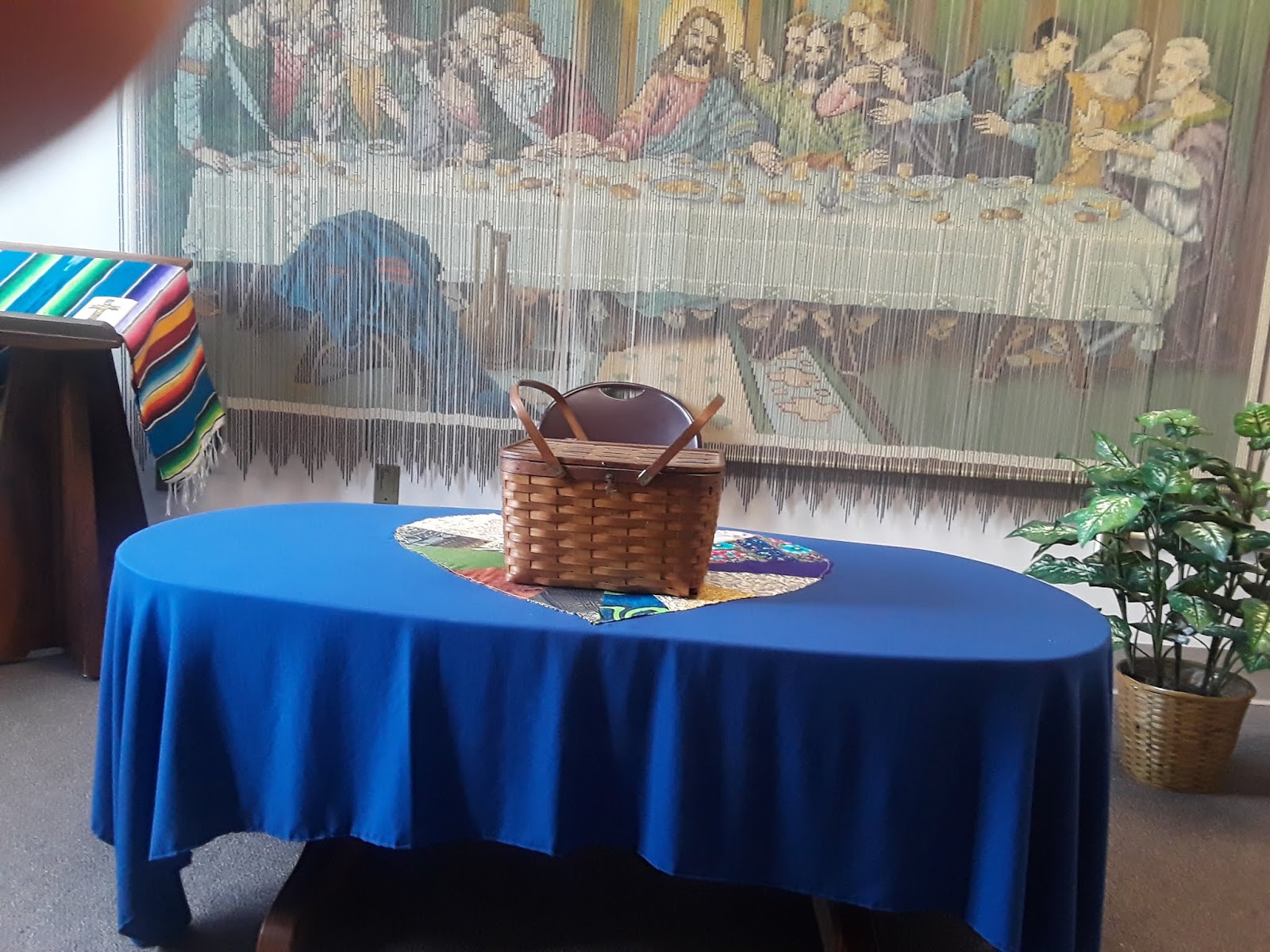
Basket Contains a Rack so You Can Carry Two Pies!


I went to the latest small group meeting for the Contemplative Formation program at Mariandale feeling that I had little to say. Each month when we don't have a weekend gathering of the whole group, five of us meet with our facilitator (Janet for our group) for a couple of hours. The meetings have proved exceptionally helpful in my making progress along this pilgrimage to a contemplative life.

We tell stories of what's been going on in our spiritual lives since the last meeting. We speak in turn listening carefully to what our pilgrim-comrades say. After everyone has spoken, we each share what was particularly relevant and meaningful to us in what we heard the others say. This is all done in a quiet, prayerful way. It's amazing to me how far each of us has traveled along this path, and while our journeys are separate, they provide insight and guidance for each other as well. A real fondness for and closeness with each other has grown among us.

The last couple of meetings had been particularly emotional and shell-shattering for me, but I felt this month had been so quiet and uneventful, I was almost embarrassed to speak about it. As I listened to the others speak, I felt my reflections growing. When my time came, I spoke about my latest conversation with Jeanine, my spiritual director, who advised me to take a break from self-examination and to take time to just observe God's creations without expectations. I also realized that I had been pushing through the required readings, trying this practice and trying that, almost in a rush to the "finish line," whatever that is. I needed to let go, to forgive myself for not being as "productive" as I might prefer.

Once I began speaking about this, I discovered that God has been doing her work with me all along, even without my asking (which is actually the whole point of this process). I spoke about how when riding the bus to work, I've been putting down my book about halfway through the ride and using the final minutes to observe my fellow passengers and to love them and to pray for them. I wish them a happy day bringing them that much closer to their dreams, free from harm and pain. When I actually spoke about it at the group, I realized how much this was affecting me as well.

There is a podcast I love, Two Feminists Annotate the Bible, in which two young women, an Anglican priest and a Bible class teacher, are going through the entire Bible and providing their insights and reactions. The priest, Jordan, spoke recently about how people have said to her, "Well, if we're all going to heaven whether we behave well or not, why shouldn't I just do whatever I want?" Jordan's response is that when you do what God wants you to do, you are rewarded in this life; to which I say, "Amen," with all my heart. Since beginning this program, I have felt God is giving me such an incredible gift, for no reason other than she loves me. A prayer I've been using recently for centering prayer includes the thought: "God doesn't love you because you are good. God loves you because she is good."
Basket has two handles for carrying

As a side note, the pictures I include this week are of a gift from one of the members of the group. I have over the course of the program talked about how I bake apple pies for the mission candidates here at Maryknoll, a sort of farewell gift of home to them before they go overseas. Baking these pies has become more and more a spiritual practice on my part, holding the missioners in my prayers as I go through each step in the process. When I mentioned this, my fellow pilgrims in the program responded, "We like apple pies, too." This week, small group member Carol gave me the basket pictured and told me it was a "pie carrier," something her mother used and that was given to her. She doesn't bake, so she thought I should have it. So our next weekend retreat (in April), I think I will have to bake two pies (there are 25 of us), one apple and one cherry, and use the carrier. It will be kind of a thank-you for this tremendous gift the program has been to me.

Mary blesses basket

Monday, January 14, 2019

Deepening Our Inner Silence Leads to Surfacing of Wounds We've Kept Hidden


The photo above is the latest of Gaynell's creations for our "altar" table. Each time we meet, Gaynell (one of the facilitators) creates a unique design to mark the season or the topic of discussion. We recently had a small group meeting around this table, and I found myself staring at this particular arrangement of wood and stone. I was drawn to the harshness and different angles; it felt particularly "Lenten" to me.

I have always been drawn to what I might call the "stark" beauty of particular places we have visited over the years, such as in Newfoundland, Iceland, and northern Scotland. These places are the most awe-inspiring to me. So I see beauty in this table design.

This past month has been marked by slow growth in my contemplative spirit. What I have been most conscious of is a growing appreciation of the people around me. Taking public transportation, I spend a lot of time among "strangers." I am striving to spend time each bus, subway, and commuter train ride to pay attention to my fellow travelers. Too often I think of other people during my commute as annoyances: talking too loudly, crowding me, blocking the doors ... I struggle to look at each person now and say a silent prayer for them to be blessed and to have a good day.

I'm not saying I don't still get frustrated or angry, but now I usually catch myself and remember that they have lives as full as mine, with desires, loves, tragedies, hopes and fears. I try not to be too quick to judge others or to take umbrage at what they do. So if you think about it, say a prayer for me to be patient and loving.

I was also reminded at the last meeting that while there are three more weekend retreats (one next week, the first since November, I can hardly wait), there is only one more small group meeting left, and my fellow pilgrims are hoping for a pie. I think I can manage that.

I'll be through with the program in June, which is a little frightening: Will I be able to continue my work?  But I think I will. The rewards have been such, I can't imagine myself just dropping the practices. I'm always trying to find more time to do the various practices I have begun and those I wish to try. I didn't know what I was going into, but I believe that God called me to this, and She will remind me if I get lazy.

Be well!  God bless you! Happy Lent!

Friday, December 14, 2018

Contemplative Development: A Hawk Announces a Breakthrough


You may know that over the years I have had a number of memorable encounters with hawks. In fact, I like to think of the hawk as my Spirit Animal. Well, I had not encountered any hawks close up for a couple of years, until the night before my latest Small Contemplative Group Meeting. I was waiting for the bus when I noticed this hawk sitting about twenty feet up in a nearby tree. Suddenly it dropped out of the tree and swooped into a nearby bush, scattering a number of little sparrows. I didn't see it for quite awhile, so I assumed it had been successful and enjoying its meal. Eventually it did come out and flew off down the road.

I posted this on Facebook and my friend Keith said it sounded like it was a Cooper's Hawk. I looked the Cooper's Hawk up on Wikipedia, and learned that this diving into brambles or bushes to seize prey was the typical hunting procedure for this bird, but this is also dangerous for the hawk, leading to broken bones and  even death as it plunges through branches and by the trunks of plants. It made me think of God sending an angel to the first Cooper's Hawk, saying, "Fear not! I have wonderful news, God has designed you for this type of hunting, where you plunge into bushes and brambles to catch tasty prey!" To which the Hawk replies, "Really? Is this a good idea? Wouldn't I be better off flying up high and diving down on mice in the wide open prairie? Or how about flying very fast and catching other birds in flight? Do I really have to fly into bushes and brambles?" And the angel says, "God loves you, and has made you this way so that this type of hunting is best for you. I think you'll find that the tastiest prey hides in bushes, and you will be the only bird able to catch and eat them!" So the Hawk shrugs and says, "I believe God loves me. Her will be done!" The End.

So the day after my hawk encounter, I had the most memorable and perhaps life-defining time of the Program at our Small Group Meeting. All along I have found the Program inspiring and moving, but I have had doubts from the beginning. Do I really belong here? Do I have the ability to be a Contemplative? Will this really change my life? Or six months after the program finishes, will I have forgotten all about the practices I have been taught and planned on using. Will life become a blah, day by day drudgery?

As we were each discussing our feelings since the last retreat, I was once again inspired by the words of my fellow pilgrims, admiring their insight and their ever-growing commitment to the Contemplative life. As I waited for my turn to speak, I thought of the various happenings in my life over the past month and tried to think of what was most relevant. I finally chose the story of my baking a pie for the mission candidates at Maryknoll: how I found myself thinking of each candidate, trying to see their faces in my mind, and how I prayed for each of them as I gathered together the dough, sliced the apples, rolled out the dough, and laid each piece of apple, one by one, within the pie shell. I then put the pie in the oven, and the smell of apples and cinnamon filled the apartment, reminding me of the process and for whom I was baking the pie. As I told the candidates, the pie probably didn't taste any better, but it made the whole process more sacred for me.

So after everyone had told their stories, and we had shared what resonated with us about each other's stories, Janet, the facilitator brought the gathering to a close. She talked about how she could tell that we were all making excellent progress, each in our own way, and how God had been calling us to this, all our lives, from birth until now. And you know, for the first time I thought, "I believe it. This is real!" I felt a rush of excitement (and still feel it now). I think I have fully accepted that this is really God's call for me.

So God sends me the Hawk, who tells me, "Do not be afraid, for I have wonderful news. God has chosen you to be a Contemplative and has provided you with the tools you will need to make the final transition." And I respond, "Really? Now that I'm 66 years old? Couldn't God have prepared me for this years ago? Say when I graduated college, so I could have a full life of being a Contemplative?" And the Hawk says, "No. You can't just become a Contemplative. You have to live and learn until you're ready. It takes many years of life and experience before you can truly been a Contemplative." "But did I really need to go through all that misery, and all those years of being an atheist, wandering in the wilderness? What good did that do me?" The Hawk says, "I know it was hard for you, but now you will be fulfilled and you will be able to help so many other people. God loves you, has loved you, and will love you forever. Now you have your reward." And I say, "I believe God loves me. Her will be done."

The End
 

Life-Changing Encounters

  I recently visited upstairs at Walsh, the building I work at currently. My office used to be on the second floor, but a few y...